
Training to Failure vs 1–3 RIR: What the New Preacher-Curl Study Found
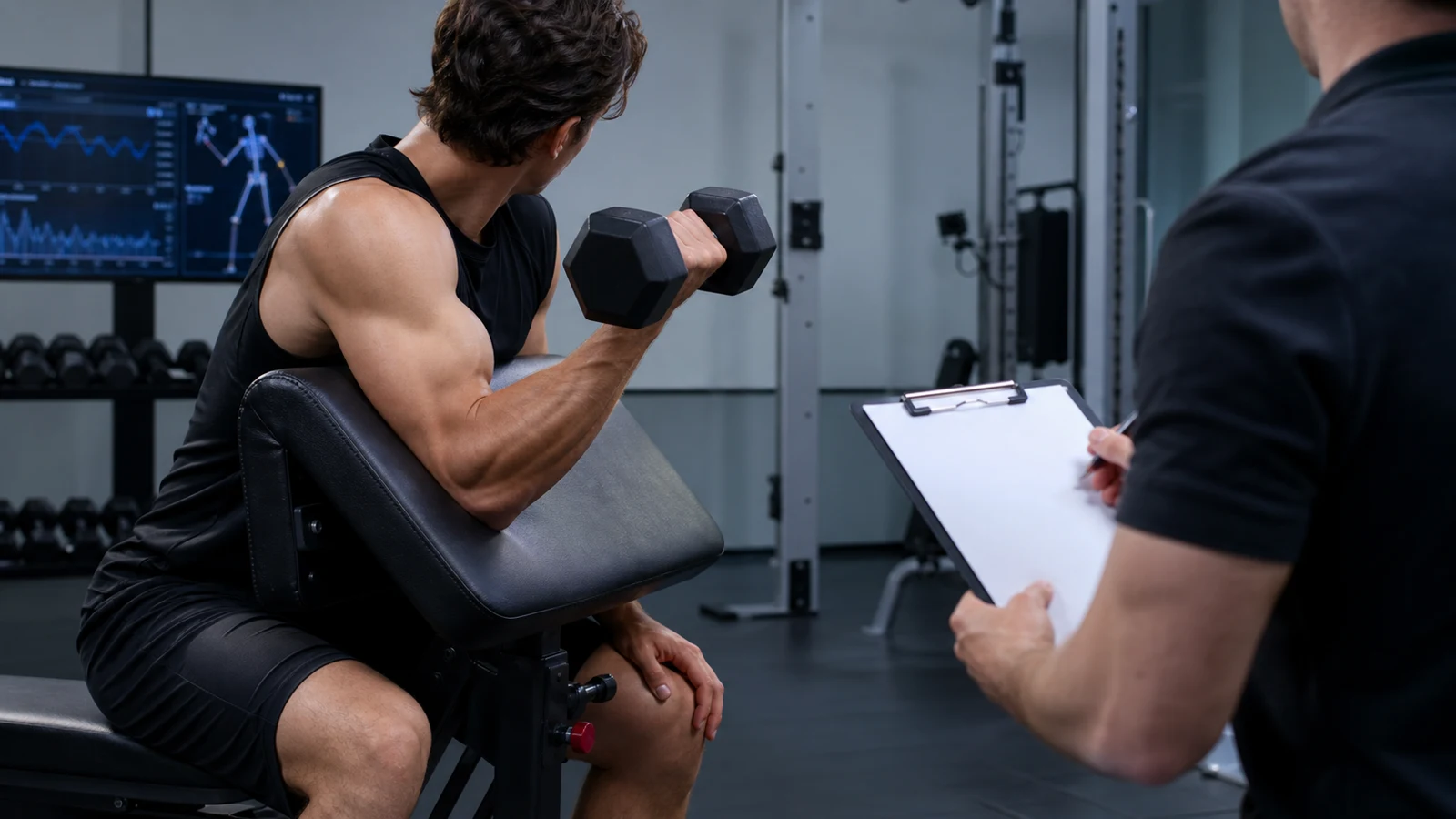
Taking every preacher-curl set to momentary failure did not produce clearly greater biceps growth or strength than stopping with one to three repetitions in reserve in a new eight-week experiment.
Both approaches worked. Nineteen resistance-trained adults improved muscle thickness and one-repetition-maximum strength while training each arm under a different condition. The estimated differences between conditions were small and uncertain, with intervals that included outcomes in either direction.
This is evidence that near-failure sets can stimulate adaptation without requiring the last possible repetition. It is not proof that failure never matters, or that all exercises and training programs behave like a single-arm preacher curl.
How the study compared failure and RIR
The peer-reviewed study in Muscles, published August 30, 2026, used a within-participant design. Each of the 19 trained adults performed unilateral preacher curls with both arms. One arm trained to momentary failure; the other stopped when the lifter estimated that one to three good repetitions remained.
Participants trained twice per week for eight weeks. Loads were set around 70–80% of one-repetition maximum, and sets targeted the eight-to-12-repetition range. The researchers matched volume between conditions, an important feature because it limits the possibility that one arm simply completed much more work.
The within-person comparison also reduces noise from genetics, diet, training history, sleep, and body size. Those factors can differ substantially between two conventional groups. Here, the failure and RIR conditions existed in the same participant.
It remains a small study. Nineteen people provide a useful controlled comparison, but not the precision needed for sweeping claims about every lifter or muscle group.
Both arms grew and became stronger
Muscle thickness increased in both conditions. The estimated between-condition difference was 0.032 centimetres, with a 95% highest-density interval from -0.044 to 0.113 centimetres. Because that interval spans zero and includes small effects favoring either approach, the result does not establish a meaningful growth advantage for failure.
Preacher-curl one-repetition maximum also improved in both arms. The estimated difference was 0.588 kilograms, with an 85% highest-density interval from -0.491 to 1.66 kilograms. Again, the uncertainty crosses zero.
The correct reading is not that the methods were proven identical. A nonsignificant or uncertain difference cannot demonstrate perfect equivalence. It means this experiment did not produce convincing evidence that one condition was better within the tested protocol.
Exploratory male and female results followed the same general pattern, but the small sample makes subgroup estimates even less precise. They are useful context, not a basis for sex-specific programming rules.
Why one to three RIR may be enough
Hypertrophy training depends on recruiting and fatiguing relevant muscle fibres across repeated hard sets. A set can be highly stimulating before the lifter fails to complete the next repetition. Stopping close to failure preserves much of that stimulus while avoiding the slowest, most fatiguing final rep.
That tradeoff can matter across a full workout. Failure on a stable single-joint exercise may carry a manageable cost. Failure on a heavy squat, deadlift, or technical Olympic lift can create more systemic fatigue and a larger technique penalty. Even within curls, repeated failure can reduce repetitions or load in later sets.
One to three RIR is not “easy training.” If the estimate is accurate, the set ends close to the point at which another clean repetition would become impossible. The study therefore compares two hard-training strategies, not serious effort against casual effort.
RIR estimates are a skill
The main practical weakness of RIR is that it must be estimated. Lifters unfamiliar with failure often stop farther away than they think. Exercise selection, repetition speed, discomfort tolerance, and motivation can all affect the estimate.
Calibration can be done without failing every set. On a stable, lower-risk exercise, a lifter can occasionally record a set, predict the RIR before stopping, and then continue under appropriate conditions to see how many clean repetitions remain. The point is to improve judgment, not to turn every session into a test.
Rep speed is another clue, but it is not a universal conversion table. A slowing concentric phase often signals proximity to failure, yet bar path, intentional tempo, and exercise mechanics influence speed. RIR should combine experience, technique quality, and the ability to complete another full repetition.
What the study cannot answer
The experiment tested one exercise and one primary muscle region for eight weeks. It does not establish the best proximity to failure for quadriceps, hamstrings, chest, back, or multi-joint strength. Nor does it reveal whether a different result would emerge over six months.
Muscle thickness is a useful outcome, but one ultrasound site cannot represent every portion of the biceps or distinguish all aspects of hypertrophy. The strength test was also specific to preacher curls. A result on that test should not be extended to general pulling strength.
Volume matching improves the comparison but changes the practical question. In an ordinary workout, a failure set and a one-to-three-RIR set may not produce identical subsequent performance. How each strategy affects total quality work across a week is part of the decision.
The study also relies on subjective RIR estimates. That reflects real training, but inaccurate estimates can blur the difference between conditions.
A practical way to use the result
Most lifters can treat one to three RIR as a productive default for repeated working sets. It keeps effort high while leaving room to maintain technique and performance. Failure can then be used selectively on stable exercises, on the final set, or during occasional calibration.
Programming should still account for exercise risk and weekly fatigue. A machine curl taken to failure is not equivalent to a free-weight compound lift taken to the same endpoint. The site's earlier review of failure versus two RIR reaches a compatible theme: the hardest possible endpoint is not automatically the most productive default.
The new preacher-curl study narrows the question with a controlled within-person design. Under its conditions, reaching failure did not clearly outperform stopping with one to three repetitions available. Lifters do not need to avoid failure, but they also do not need to chase it on every set to justify a hypertrophy session.
More Training
 Training
Slow vs Traditional Squat Tempo to Failure: What the Study Found
A crossover study compared slow and traditional barbell squats taken to failure. The tempos redistributed stress rather than producing one universal winner.
 Training
Flywheel Training Microdosing: One Set Daily vs One Weekly Session
A six-week trial split the same 30 flywheel leg-press sets into daily microdoses or one weekly session. Strength gains were similar, but soreness and architecture differed.
 Training
Resistance Bands vs Free Weights for Older Adults: Results of a 12-Week Trial
A 12-week randomized trial found that elastic-band and free-weight programs both improved several functional tasks in adults around age 67, with no clear overall winner.