
Resistance Bands vs Free Weights for Older Adults: Results of a 12-Week Trial
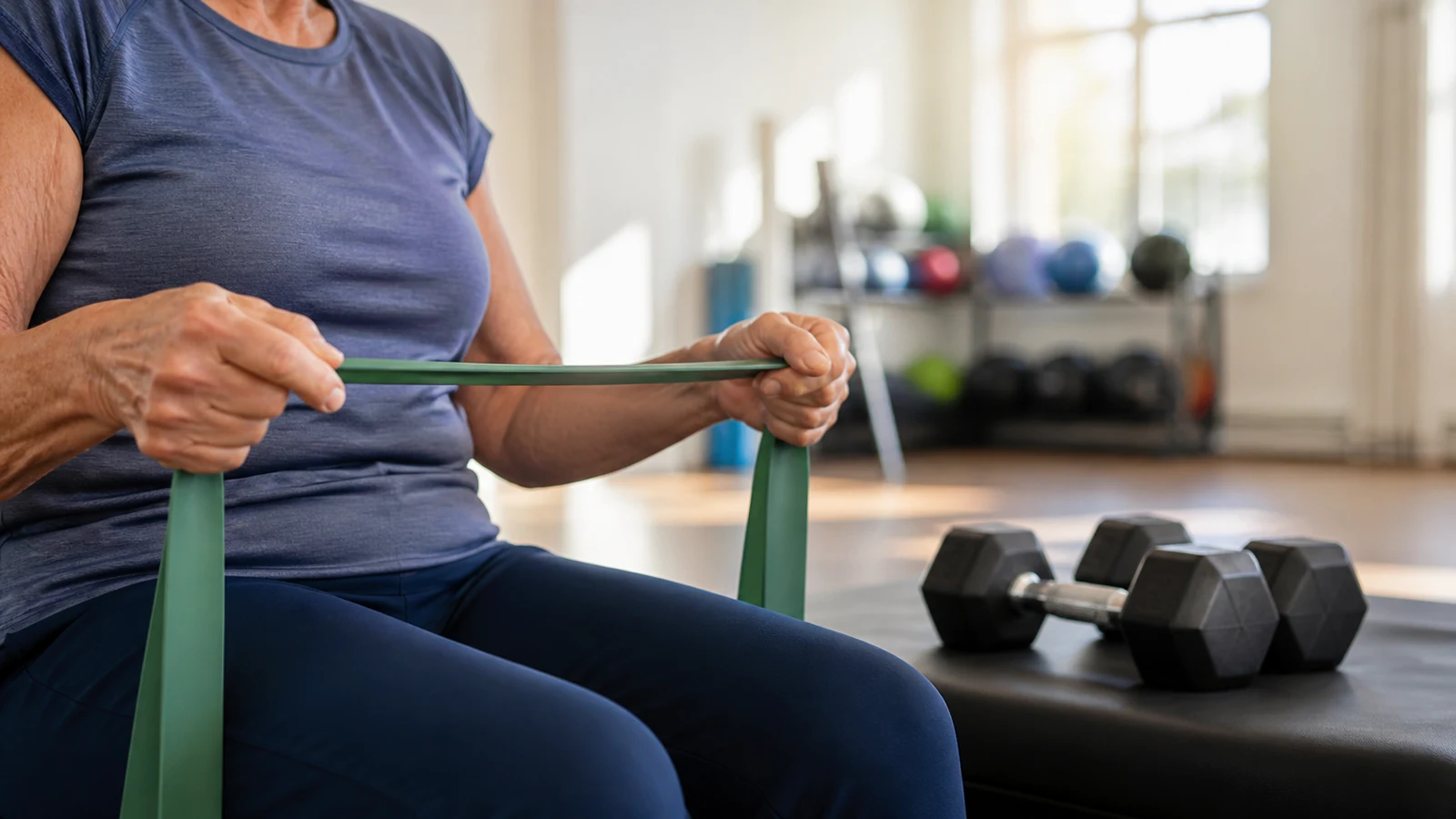
Elastic bands and free weights both improved several everyday performance measures in a 12-week randomized trial of older adults. Neither method emerged as a clear overall winner.
The study assigned 48 adults with an average age of 67.1 years to free-weight training, elastic-resistance training, or a non-training control group. The two exercise groups trained twice weekly using five whole-body movements. Both improved stair climbing, chair rising, box lifting, and a loaded mobility test compared with where they started.
The useful message is access, not a contest between tools. A well-organized band program can produce meaningful functional changes, while free weights remain an effective and easily progressed option.
What the researchers tested
The trial in Experimental Gerontology included 28 men and 20 women. Sixteen participants were allocated to free weights, 17 to elastic resistance, and 15 to the control condition.
Training ran for 12 weeks at two sessions per week. Both exercise groups completed five whole-body exercises, allowing a more direct comparison than studies that test entirely different routines. Researchers assessed practical tasks and strength before and after the intervention.
The sample was modest, so small differences between the two training methods could be missed. Random assignment improves confidence that the intervention caused the changes, but it does not turn 48 participants into a definitive ranking of all band and weight programs.
Functional tasks improved with both methods
The reported within-group changes show why both options deserve attention. Stair-climbing performance improved by 11.4% in the free-weight group and 11.5% in the elastic-resistance group. Chair-rise performance improved by 10.2% and 19.8%, respectively.
The box-lift task improved by 31.8% with free weights and 44.8% with elastic resistance. Loaded timed up-and-go performance improved by 7.1% and 11.1%.
Those percentages should not be read as proof that bands were superior. A larger percentage in one small group can result from baseline values, variability, or chance. The main comparison did not establish a consistent between-method advantage.
Functional tests also reflect practice specificity. A program can improve a task because it strengthens the involved muscles, improves coordination, or simply resembles the tested movement. This is still valuable, but it is not the same as showing that every aspect of physical function improved.
Strength findings need careful wording
The study assessed chest-press and leg-press strength. Reported improvements were 7.3% versus 3.6% for chest press and 16.8% versus 23.9% for leg press in the free-weight and elastic groups. The relevant comparisons did not show a statistically clear advantage over the control condition for these strength outcomes.
That result does not mean the participants became weaker or that resistance training cannot improve strength after 60. It means the measured strength findings were not precise enough in this trial to support a strong comparative claim.
Testing can also favor familiarity. A person trained and tested on a similar device may express force differently from someone whose primary resistance came from bands. Larger trials with standardized progression and multiple strength measures would help distinguish real adaptation from test specificity.
Why bands can work
Muscle responds to tension and effort, not to the marketing category of the equipment. Elastic resistance increases as a band stretches. With appropriate setup, range of motion, and proximity to fatigue, it can challenge the major muscle groups.
Bands are portable, relatively inexpensive, and useful where storage or travel limits equipment. They can also make it easier to adjust an exercise around a comfortable path. For someone who will consistently use a band but cannot regularly reach a gym, that accessibility is a genuine training advantage.
The limitations are practical. Resistance is harder to quantify than a marked weight stack, band tension changes across the movement, and products vary. Bands can degrade or slip if poorly anchored. A program needs a progression system—stronger bands, more stretch, more repetitions, additional sets, or a harder exercise variation—rather than repeating the same easy session indefinitely.
Why free weights remain useful
Dumbbells and barbells make external load straightforward to record. Small plates or adjustable dumbbells can support gradual progression, and a large exercise library is available. Free weights also require control of the implement through space, which can be appropriate when balance and technique are managed.
They are not automatically better. The load that matters is the one a person can use safely and progressively. A heavy dumbbell that cannot be positioned confidently is less useful than a band exercise performed through an appropriate range with consistent effort.
Equipment choice should account for joint comfort, grip, balance, available supervision, and the goal of the program. People with significant medical or mobility limitations may need individual assessment before beginning.
Turning either tool into a program
Two sessions per week were enough to produce changes in this trial, but frequency alone does not describe the dose. Each major movement pattern needs a challenging and repeatable exercise, with workload increased as performance improves.
A simple full-body structure might include a squat or chair-rise pattern, a hip-dominant movement, a row, a press, and a loaded carry or trunk task. Bands can supply all five; so can free weights. Machines and bodyweight variations can also be combined when they solve a specific access or technique problem.
The ACSM resistance-training guidelines emphasize consistent resistance exercise and progressive challenge rather than loyalty to one implement. Recording sets, repetitions, band or load, and perceived difficulty helps show whether a program is actually advancing.
The result to carry forward
This trial supports elastic resistance as a credible alternative to free weights for several functional outcomes in generally healthy older adults. It does not prove the methods are identical, and it does not identify one as universally superior.
The best choice may be the method a person can perform safely, progress over time, and sustain for months. Bands lower several access barriers. Free weights simplify loading. A mixed program can use the strengths of both without treating the decision as permanent.
More Training
 Training
Slow vs Traditional Squat Tempo to Failure: What the Study Found
A crossover study compared slow and traditional barbell squats taken to failure. The tempos redistributed stress rather than producing one universal winner.
 Training
Flywheel Training Microdosing: One Set Daily vs One Weekly Session
A six-week trial split the same 30 flywheel leg-press sets into daily microdoses or one weekly session. Strength gains were similar, but soreness and architecture differed.
 Training
Training to Failure vs 1–3 RIR: What the New Preacher-Curl Study Found
An eight-week within-person study found similar biceps growth and preacher-curl strength when trained lifters reached failure or stopped with one to three reps in reserve.