
Velocity Loss in Concurrent Training: The 0%, 15%, and 40% Study
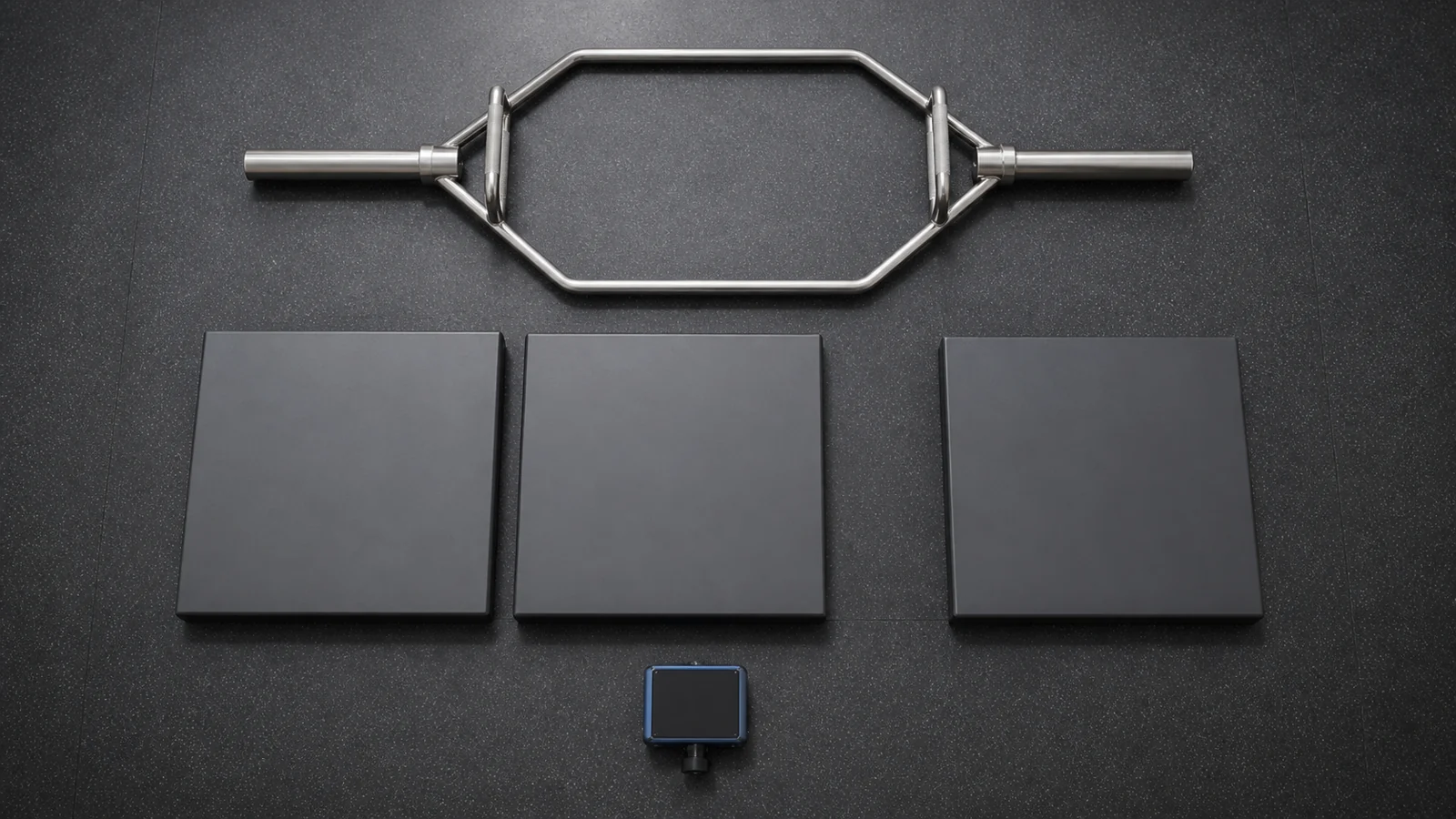
The threshold map is the starting point for reading this concurrent-training study:
| Group | Squat stopping rule | Total squat repetitions | Training modes |
|---|---|---|---|
| VL0 | Stop before measurable velocity loss | 48 | Squat + run |
| VL15 | Allow about 15% velocity loss | 152 | Squat + run |
| VL40 | Allow about 40% velocity loss | 297 | Squat + run |
| ET | No resistance work | 0 | Run only |
The 0%, 15%, and 40% labels therefore represented different fatigue thresholds and sharply different resistance-training volumes.
How the thresholds worked
Velocity loss tracks how much repetition speed falls within a set relative to its fastest repetition. A low threshold stops the set before speed drops much; a high threshold permits more slowing and, generally, more accumulated repetitions and fatigue. The percentage is a performance threshold measured with velocity data, not a percentage of the load on the bar.
The randomized study included 41 moderately trained men. Ten were assigned to VL0, ten to VL15, eleven to VL40, and ten to endurance training only.
The concurrent-session sequence
Across eight weeks, all groups trained twice weekly. Concurrent groups squatted at 70%–85% of one-repetition maximum, rested 10 minutes, then ran at 90%–105% of maximal aerobic speed. Programmed running duration moved from 18 to 8 minutes across the intervention. The order was always resistance work before endurance work.
The thresholds produced very different resistance-training exposures. In the full paper, total squat repetitions across the intervention averaged 48 in VL0, 152 in VL15, and 297 in VL40. That is crucial context: the comparison was not three equal-volume strength programs with fatigue as the only difference. Higher allowed velocity loss also generated substantially more repetitions.
If the goal is hypertrophy
All three concurrent groups increased muscle mass, while the endurance-only group did not. VL40 recorded the largest gains, and the group-by-time interaction for one vastus lateralis cross-sectional-area site was significant at p=.04. The journal paper measured cross-sectional area at multiple femur locations and estimated vastus lateralis muscle volume, so “muscle mass” here refers to those study measures rather than whole-body growth.
If the goal is strength
VL15 and VL40 improved one-repetition maximum more than endurance-only, with a group-by-time interaction of p=.009. Those two groups also improved strength-related variables. Endurance-only produced no strength gains and showed a significant reduction in rate of force development measured at 400 milliseconds.
The VL0 group still performed resistance training, but its sets were stopped after the first qualifying repetition to prevent speed loss. That kept accumulated repetitions extremely low. Comparing it with VL40 is therefore partly a comparison between minimal and much larger squat volumes, not simply fresh versus fatigued repetitions.
Jump and sprint results add restraint to the story. The study reported no significant time effect or group-by-time interaction for countermovement jump or sprint variables. More muscle or a better squat 1RM did not automatically translate into a detected improvement in every performance test over eight weeks.
If the goal is endurance
Maximal aerobic speed improved in all four groups at p<.001. Endurance-only achieved the greatest gains. Among the concurrent groups, the lower the resistance-training velocity loss, the larger the effect size for maximal aerobic speed; the group-by-time interaction was p=.04.
The authors interpreted this pattern as evidence that fatigue induced during resistance training may attenuate endurance adaptations. The order and recovery interval make that explanation plausible within the protocol: squats came first, and the run started 10 minutes later. The VL40 group had performed far more repetitions and sometimes completed a smaller proportion of the prescribed running distance at 90% and 95% of maximal aerobic speed.
“May attenuate” is the right level of confidence. There was no resistance-only group, so the study cannot compare the concurrent programs with strength training performed without running. It also cannot tell us whether separating the two sessions by six hours, placing running first, or training them on different days would preserve the same pattern.
Scope limits before choosing a threshold
If muscle and squat strength are the priority inside this exact concurrent setup, 15% and 40% supplied more meaningful resistance work than 0%, and VL40 produced the largest muscle-size result. If maximizing the subsequent running adaptation is the priority, lower resistance fatigue aligned with the better aerobic effect, while endurance-only improved maximal aerobic speed most.
That does not make 15% a proven universal compromise. The sample was small, male, and moderately trained. The intervention lasted eight weeks, used squats, and paired them with high-intensity running after a fixed 10-minute separation. Different exercises, velocity devices, endurance modes, or weekly schedules can change both the fatigue generated and the adaptations available.
The thresholds also should not be confused with repetitions in reserve. A set can reach a given velocity loss at different perceived distances from failure depending on load, exercise, individual characteristics, and measurement. Our review of failure versus two RIR covers a different stopping method and a resistance-only single-set program.
A reading guide for concurrent athletes
The first question is whether the program is actually concurrent. A bodybuilder who performs only resistance training does not face the study's immediate squat-to-run transition, so using this paper to dictate hypertrophy sets would exceed the evidence. A field-sport or endurance athlete combining both modes has a closer match.
The second question is which adaptation cannot be compromised. When the running session is important, controlling fatigue in the preceding squat work may help preserve its quality. When strength and muscle are essential, an almost fatigue-free 0% threshold may provide too few repetitions in a setup like this one. Adjusting the distance between sessions is another option, but it was not tested here.
Finally, count the work rather than looking only at the threshold label. VL40 accumulated more than six times the total squat repetitions of VL0 in this trial. The site's volume-and-frequency analysis reinforces why a higher-work condition should not be interpreted as a pure fatigue signal.
Use the trial as a sequence of questions. Are strength and endurance trained in the same session? Does resistance work come first? Is the recovery interval close to 10 minutes? Is running quality or hypertrophy the less negotiable outcome? The farther a program moves from those conditions, the less confidently its threshold can be borrowed from this experiment.
More Training
 Training
Slow vs Traditional Squat Tempo to Failure: What the Study Found
A crossover study compared slow and traditional barbell squats taken to failure. The tempos redistributed stress rather than producing one universal winner.
 Training
Flywheel Training Microdosing: One Set Daily vs One Weekly Session
A six-week trial split the same 30 flywheel leg-press sets into daily microdoses or one weekly session. Strength gains were similar, but soreness and architecture differed.
 Training
Resistance Bands vs Free Weights for Older Adults: Results of a 12-Week Trial
A 12-week randomized trial found that elastic-band and free-weight programs both improved several functional tasks in adults around age 67, with no clear overall winner.