
Creatine With Resistance Training After 60: Strength, Muscle, and Function Evidence
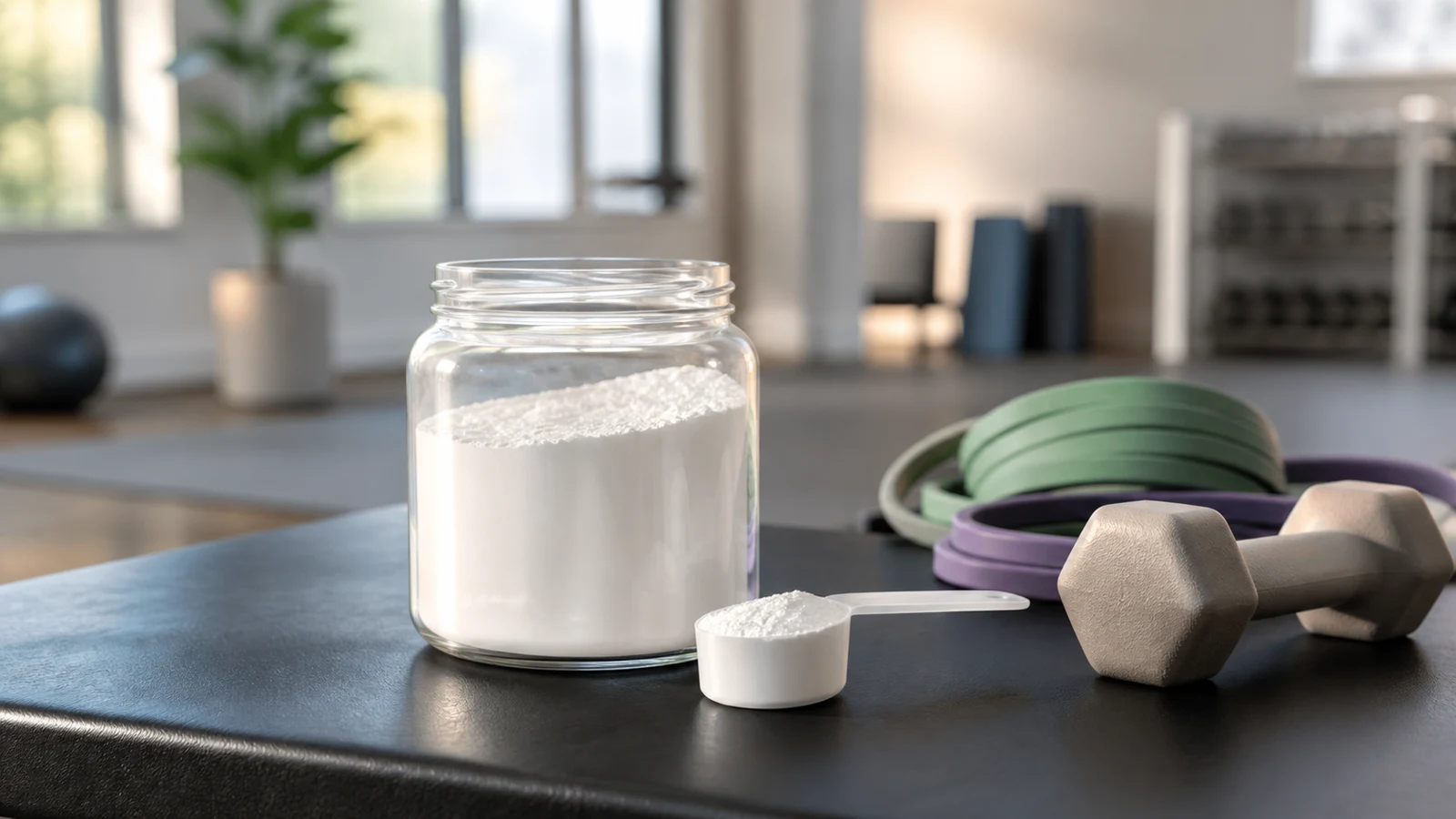
Creatine added a modest strength benefit to resistance training in adults aged 60 and older in a 2026 meta-analysis. The pooled results for muscle mass and physical function leaned positive but remained statistically uncertain.
That difference in certainty matters. Eleven randomized trials support a small average strength effect with moderate confidence. Fewer studies and wider intervals make it harder to know whether the apparent muscle and function benefits represent reliable effects or sampling noise.
Creatine should therefore be understood as a possible addition to progressive training, not a substitute for it and not a guaranteed treatment for age-related muscle loss.
What the researchers analyzed
The systematic review and meta-analysis in Frontiers in Nutrition was published August 25, 2026. It included 11 randomized controlled trials in adults aged at least 60 who completed resistance training with creatine or an appropriate comparison.
The researchers grouped outcomes into muscular strength, muscle mass, and physical function. Because studies can report several measures—different exercises, body-composition tests, or functional tasks—the analysis used multiple effect sizes and models designed to account for that structure.
Most participants were generally healthy older adults. That improves relevance to community exercise but limits extrapolation to frail adults, people with diagnosed sarcopenia, or patients with major clinical restrictions.
Strength showed the clearest benefit
Across 42 strength effect sizes, creatine plus resistance training produced a standardized effect of 0.31, with a 95% confidence interval from 0.18 to 0.45. The evidence was rated moderate certainty.
An effect of 0.31 is modest, not transformative. It suggests that the creatine groups improved somewhat more on average than the training-only comparators. The confidence interval remained on the beneficial side of zero, making this the most stable of the three outcome groups.
Strength is also highly relevant to daily life, but a standardized effect does not translate into one guaranteed number of kilograms on every exercise. Included trials used different tests and programs. Baseline strength, adherence, supervision, and the movement tested influence the result.
The conclusion should be “a small average added benefit is supported,” not “creatine makes every older lifter dramatically stronger.”
Muscle mass was promising but uncertain
The muscle-mass analysis contained eight effect sizes from six studies. Its standardized effect was 0.35, with a confidence interval from -0.09 to 0.78 and a p value of .102. Evidence certainty was rated low.
The central estimate favors creatine, but the interval includes no effect and a substantially larger benefit. That range is too broad for a confident claim that creatine added muscle mass across the included population.
Body-composition methods complicate interpretation. Creatine can increase water stored within muscle, while different tools vary in their ability to distinguish water, lean tissue, and contractile growth. Longer trials using direct and consistent measures would produce a clearer estimate.
None of this means the muscle-mass hypothesis failed. It means the current pooled evidence is less certain than the strength evidence.
Physical-function evidence was least certain
Physical function included 10 effect sizes from three studies. The pooled effect was 0.47, with a confidence interval from -0.08 to 1.03 and a p value of .086. Certainty was rated very low.
Only three studies contributed to this outcome, and the wide interval includes both little effect and a large one. Different functional tests may also respond differently. A chair rise, walking test, and task requiring balance are related to independence but do not measure the same capacity.
It would be premature to promise that creatine improves day-to-day function on the basis of this estimate. Resistance training itself remains the active foundation, and task-specific practice may be needed to transfer strength to a particular activity.
No stable moderator explained the response
The authors examined possible moderators but did not find stable variables that consistently explained the results. That means the meta-analysis cannot supply a reliable rule such as “this age group,” “this program length,” or “this participant type” always benefits more.
A nonsignificant moderator is not proof that individual differences do not exist. Moderator analyses need enough studies and variation to detect patterns. With 11 trials overall and fewer for some outcomes, statistical power is limited.
This is another reason to avoid turning a population average into a personalized prediction.
Creatine does not replace the program
Every included comparison sits on top of resistance training. Creatine cannot provide progressive loading, movement skill, balance practice, or adherence. Those come from the program.
A useful routine trains major movement patterns with loads that can be progressed while fitting the person's joint tolerance and available equipment. The companion trial on resistance bands versus free weights for older adults shows that multiple tools can improve function when organized into consistent training.
Sleep, adequate energy, and sufficient protein also remain relevant. Adding a supplement while the training stimulus or diet is inconsistent is unlikely to reproduce the conditions of a controlled trial.
Safety and individual decisions
Creatine monohydrate is one of the most studied sports supplements, but an article cannot determine whether it is appropriate for a particular person. Older adults may use prescription medicines or manage kidney, cardiovascular, metabolic, or other conditions that change the decision.
A clinician or pharmacist who knows the person's history can evaluate potential concerns and interpret laboratory tests. Product quality matters as well; an unbranded powder in an online listing is not evidence of purity.
This review does not provide a personalized dose or protocol. Trial regimens differ, and copying one number without considering health status, diet, and medical advice would overstate what a meta-analysis can do.
The balanced takeaway
For generally healthy adults over 60 who already resistance train, the 2026 analysis supports a modest additional strength benefit from creatine with moderate certainty. The muscle-mass result is plausible but low certainty, and the physical-function result is very uncertain.
That hierarchy is more useful than grouping all three outcomes under “creatine works.” It shows where evidence is relatively firm and where more trials are needed. Creatine may be a reasonable topic to discuss with an appropriate professional, but progressive resistance training remains the part no supplement can replace.
More Diet
 Diet
DietVegan Diet, Muscle Loss, and Resistance Training in Older Adults: New Trial
In a 12-week trial, a self-selected vegan diet reduced protein intake and muscle measures in adults over 65. Resistance training mitigated, but did not erase, the losses.
 Diet
DietFood Order for Athletes: Carbs First or Vegetables and Protein First?
In 14 trained footballers, eating carbohydrate last lowered the early glucose rise but increased hunger and cravings. Later food intake did not change.
 Diet
DietDo More Carbs Build More Muscle? What the 2026 Meta-Analysis Found
A 2026 meta-analysis found no clear independent hypertrophy advantage from higher carbohydrate intake when resistance-training studies were pooled, but the evidence remains limited.