
Whey Plus Collagen During Resistance Training: Reading the New Trial
The registration date changes how this whey-plus-collagen trial should be read. ClinicalTrials.gov lists primary completion on March 10, 2024, overall study completion on April 10, 2024, and first submission on September 6, 2025—roughly 18 months after primary completion. The paper was published in July 2026.
That chronology does not prove the findings are false. It removes one of prospective registration’s main safeguards: a time-stamped account of planned outcomes and analyses created before the outcome data are available.
January 2024 to July 2026
The ClinicalTrials.gov record also lists an actual start date of January 3, 2024. Its chronology places the first submission after both completion dates. The journal article was published July 9, 2026.
Prospective registration helps deter outcome switching because readers can compare a publication with a protocol frozen before results are known. Retrospective registration cannot provide the same independent sequence. It can still disclose study information, but the record and paper must be interpreted with the timing visible.
This is especially relevant when a small trial reports large advantages across several outcomes.
What happened during the eight weeks
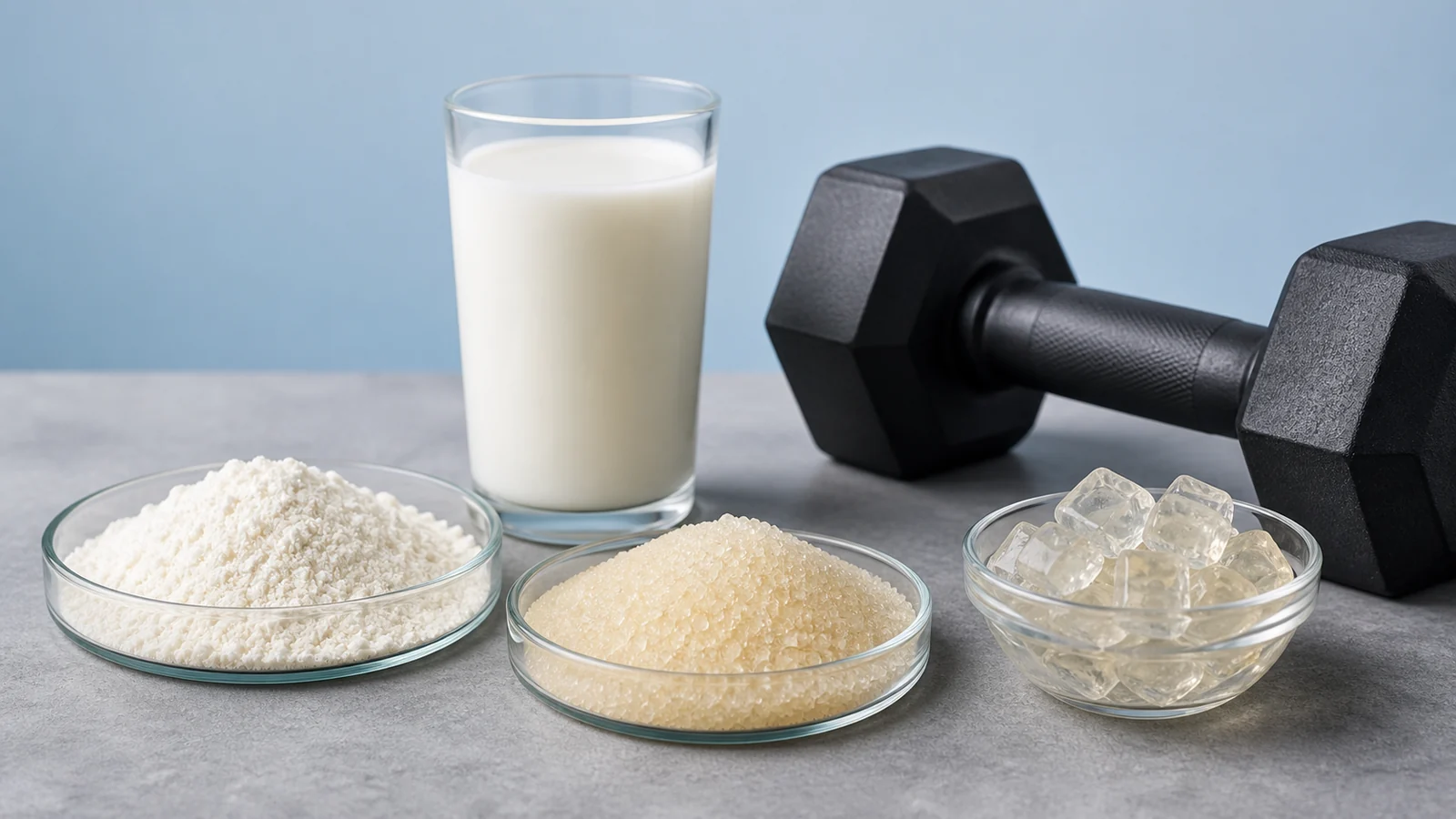
The PubMed record describes 52 men screened and 40 resistance-trained men enrolled. All 40 completed the intervention. They were randomized into four groups of roughly 10 participants:
| Group | Daily condition |
|---|---|
| Combination | 30 g whey plus 10 g collagen |
| Whey | 30 g whey |
| Collagen | 10 g collagen |
| Placebo | 10 g maltodextrin |
All participants completed supervised resistance training three times per week. The primary outcome was muscle mass estimated by bioelectrical impedance analysis. Secondary outcomes included lumbar-spine bone mineral density by DXA, squat and bench-press 1RM, plus the bone-turnover markers P1NP and CTX-I.
Four arms are useful because the combination can be compared with each component and placebo. Ten people per arm are fragile. A few unusually large or small responses can shift the mean, and randomization has little room to balance every baseline characteristic.
Complete follow-up avoids attrition complicating the comparison, but it does not increase the effective sample. Four simultaneous estimates also create more opportunities for an apparently extreme contrast than a simple two-arm trial. Confidence intervals, baseline values, and the complete statistical plan matter alongside the reported change scores.
The publication’s outcome sequence
The combination group had the largest reported muscle-mass change: 2.66 kilograms. Whey alone increased by 1.59 kilograms, collagen by 0.46 kilograms, and placebo by 0.10 kilograms. The paper reported significant between-group differences.
Strength followed the same ordering. Squat 1RM increased by 15.22 kilograms and bench-press 1RM by 10.63 kilograms in the whey-plus-collagen group. Whey and collagen groups followed, while placebo showed the smallest changes.
Lumbar-spine BMD increased by a reported 0.108 grams per square centimeter with the combination and 0.023 g/cm² with collagen. Whey and placebo did not show significant BMD changes. P1NP increased and CTX-I fell most in the combination group, according to the report.
The numbers are study averages, not expected personal gains. Their consistency across muscle, strength, bone density, and turnover markers makes the pattern interesting. The same consistency, large reported changes, and tiny groups raise the value of independent replication.
“Muscle mass” came from BIA
Bioelectrical impedance estimates body composition from resistance to an electrical current and prediction equations. Hydration, glycogen, food intake, recent exercise, and testing conditions can affect the estimate.
The reported 2.66-kilogram increase should therefore remain a change in the study’s BIA-derived muscle-mass measure. It cannot be restated as 2.66 kilograms of newly built contractile tissue. Direct imaging at multiple muscle sites or a more robust body-composition protocol could test whether the magnitude repeats.
Training can also alter fluid and glycogen status. In a supplement experiment, standardizing measurement conditions becomes central. The paper’s result may reflect true tissue change, measurement sensitivity, or a mixture; BIA alone cannot partition those possibilities.
This is different from saying the measurement is worthless. BIA can track group change when conditions are controlled. It is weaker than the headline precision implies when four groups contain about 10 people each.
Eight weeks is a difficult bone window
DXA is an established method for areal bone mineral density, but clinically meaningful bone change is normally interpreted across longer periods. Positioning, precision error, body-composition change, and the short interval complicate an eight-week lumbar-spine comparison.
Bone-turnover markers add biological context. P1NP relates to formation activity, while CTX-I relates to resorption. Neither marker proves stronger bone, a durable BMD gain, or fewer fractures. The trial recorded no fracture outcome.
The combination’s reported 0.108 g/cm² lumbar change deserves verification under prospective registration, a longer follow-up, repeated DXA quality controls, and enough participants to estimate normal variation. Calling the trial “proof” of rapid bone building would outrun both the duration and the endpoint.
A stronger replication would register outcomes and analysis before enrollment, publish a detailed protocol, recruit enough participants for stable four-arm estimates, and include women and a wider age range. It would follow bone outcomes for substantially longer than eight weeks and use complementary muscle measurements.
Habitual protein and energy intake would also need close reporting. A combination can only be interpreted relative to what participants already eat. The supervised training program should remain standardized because training itself drives strength adaptation.
Readers can compare this unusually positive supplement signal with the site’s omega-3 resistance-training trial review, which found no added hypertrophy or strength despite biological changes. The contrast is a reminder to inspect methods in both positive and null trials.
For now, the paper documents a favorable eight-week pattern for whey plus collagen. The retrospective timeline, small arms, BIA primary outcome, and short bone window determine how much confidence that pattern can carry.
More Diet
 Diet
DietVegan Diet, Muscle Loss, and Resistance Training in Older Adults: New Trial
In a 12-week trial, a self-selected vegan diet reduced protein intake and muscle measures in adults over 65. Resistance training mitigated, but did not erase, the losses.
 Diet
DietFood Order for Athletes: Carbs First or Vegetables and Protein First?
In 14 trained footballers, eating carbohydrate last lowered the early glucose rise but increased hunger and cravings. Later food intake did not change.
 Diet
DietCreatine With Resistance Training After 60: Strength, Muscle, and Function Evidence
A 2026 meta-analysis of 11 trials found a modest strength benefit when adults over 60 combined creatine with resistance training, while muscle and function estimates remained uncertain.