
Beetroot Juice vs Creatine: What a 72-Hour Resistance Trial Found
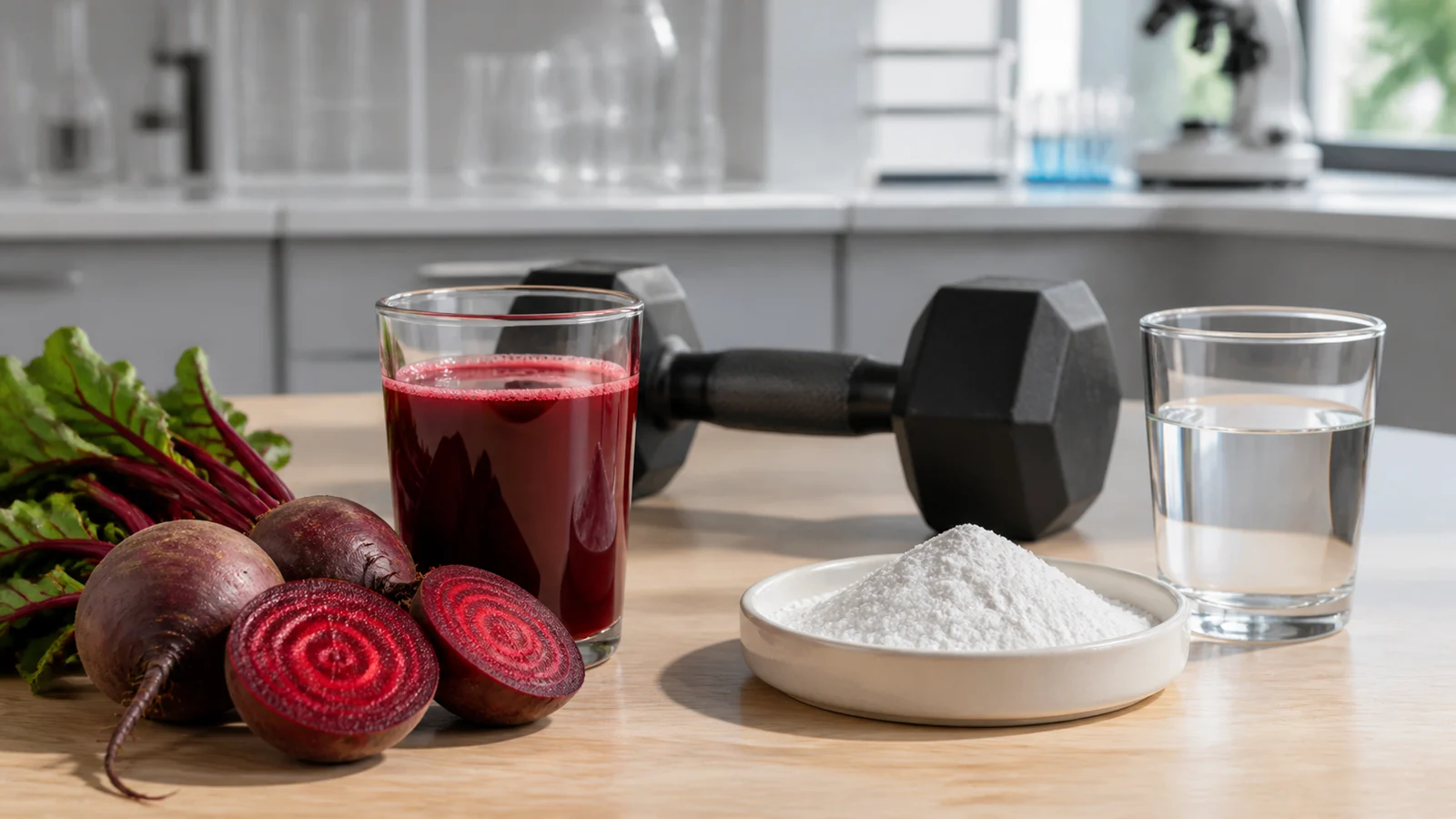
Asking whether beetroot juice or creatine “won” this trial hides the result. The answer changed with the outcome. Creatine produced the clearest repetition result at one bench-press load. Beetroot juice produced the stronger velocity pattern and the broader set of oxygenation, heart-rate, and heart-rate-variability findings. The experiment lasted roughly 72 hours, so none of those results settles long-term strength or muscle gain.
The PubMed record and journal publication describe a randomized, double-blind, placebo-controlled crossover study in 11 healthy men with novice resistance-training experience. Each man completed the creatine, beetroot-juice, and placebo conditions. Bench press and back squat were tested at 60%, 70%, and 80% of one-repetition maximum.
Here is how to read each outcome without turning different measurements into a single scoreboard.
Repetitions: creatine’s result was narrow and clear
Participants performed sets to failure. Compared with placebo, creatine significantly improved bench-press repetitions at 80% 1RM, with a reported effect size of 1.33. That is the trial’s most direct result for work capacity.
The precision matters. The paper did not report a blanket repetition advantage for every load and both lifts. “More repetitions at 80% 1RM in the bench press” should not become “more repetitions in any workout.” A heavier bench set in a controlled session is also different from a tested increase in 1RM.
Creatine was loaded at 0.3 grams per kilogram per day, described as roughly 20–25 grams daily. That amount explains the experiment; it is not individualized guidance. Readers comparing timeframes can look at the site’s four-week creatine trial in vegan athletes, which used another population and other performance tests. Results from one design cannot simply be pasted onto the other.
Velocity: both conditions moved, beetroot moved more
Both active conditions affected movement velocity. The authors characterized the effects as moderate to very large and reported larger effects for beetroot juice, with effect sizes of 1.40–2.82 versus placebo.
Velocity gives information that a repetition count misses. A participant can move a load faster without completing additional repetitions, and a condition can improve repetitions without changing every velocity measure. This trial measured both, which is why the answer splits instead of producing one supplement ranking.
It would still be premature to write a rule such as “beetroot is for speed.” Eleven novice-trained men completed a short laboratory comparison. The trial did not follow bar speed across a training block, test whether faster repetitions yielded more strength, or establish whether the effect persists after repeated nitrate exposure.
Muscle oxygenation: a local signal, not hypertrophy
The beetroot condition produced higher intramuscular oxygen saturation than both creatine and placebo. Reported effect sizes ranged from 1.74 to 2.9. The beetroot powder supplied about 450 milligrams of nitrate on the first and final days, with divided servings on the middle days.
Muscle oxygen saturation is a physiological measurement taken around the exercise task. It does not directly measure new muscle tissue, protein synthesis, or recovery between weekly sessions. A large short-term effect on this signal can be real while its importance for chronic adaptation remains unknown.
That distinction appears elsewhere in supplement research. In the site’s omega-3 resistance-training review, biological incorporation did not produce extra hypertrophy or strength. Mechanism and tissue-level signals help explain what might be happening; they do not substitute for the endpoint a lifter actually wants to know.
Heart rate and HRV: recovery-related, not a recovery verdict
Peak heart rate was lower with beetroot juice than with the other conditions, with reported effect sizes of 0.83–2.74. Heart-rate variability after exercise also appeared more favorable. For RMSSD, one commonly reported HRV measure, effect sizes ranged from 0.91 to 2.99.
These findings describe the cardiovascular and autonomic response to the tested sessions. They do not show fewer missed workouts, faster performance recovery over several days, or better adaptation over months. Lower peak heart rate is not automatically desirable in every sporting context, and one post-exercise HRV profile is not a full recovery assessment.
The authors also examined how many individuals showed changes judged meaningful and reported a larger proportion following beetroot juice. With only 11 participants and many measured outcomes, that analysis is exploratory. Apparent responder categories can shift when the same person repeats a test, especially near a measurement threshold.
What the crossover design contributes
Because each man completed all three conditions, the experiment reduced some noise caused by comparing naturally different groups. Randomization, blinding, a matched placebo, and seven-day washouts strengthen the acute comparison. A participant’s bench performance under creatine could be compared with his own performance under beetroot juice and placebo.
The crossover cannot solve every problem. The sample was very small, male, healthy, and novice trained. The exposure was short, and the report was a secondary analysis with many acute outcomes. Women, experienced strength athletes, older adults, and people with relevant health conditions were not represented by this group.
Nor did the study include a creatine-plus-beetroot condition. It provides no evidence that combining them would preserve the best result from each condition or improve anything further. It did not assess long-term safety, hypertrophy, chronic strength development, or injury.
For repetition capacity, the specific positive result belonged to creatine in the 80% 1RM bench press. For movement velocity and the measured physiological response, beetroot juice produced the wider pattern. The trial did not ask which supplement should anchor a full training cycle.
Claims that beetroot juice replaces creatine, that creatine is irrelevant to velocity, or that either condition builds more muscle cross the study’s boundary. Seventy-two hours can reveal what changed in those sessions. It cannot tell us what accumulates after twelve weeks.
More Diet
 Diet
DietVegan Diet, Muscle Loss, and Resistance Training in Older Adults: New Trial
In a 12-week trial, a self-selected vegan diet reduced protein intake and muscle measures in adults over 65. Resistance training mitigated, but did not erase, the losses.
 Diet
DietFood Order for Athletes: Carbs First or Vegetables and Protein First?
In 14 trained footballers, eating carbohydrate last lowered the early glucose rise but increased hunger and cravings. Later food intake did not change.
 Diet
DietCreatine With Resistance Training After 60: Strength, Muscle, and Function Evidence
A 2026 meta-analysis of 11 trials found a modest strength benefit when adults over 60 combined creatine with resistance training, while muscle and function estimates remained uncertain.