
Plant vs Animal Protein for Muscle: What the 12-Week Trial Shows
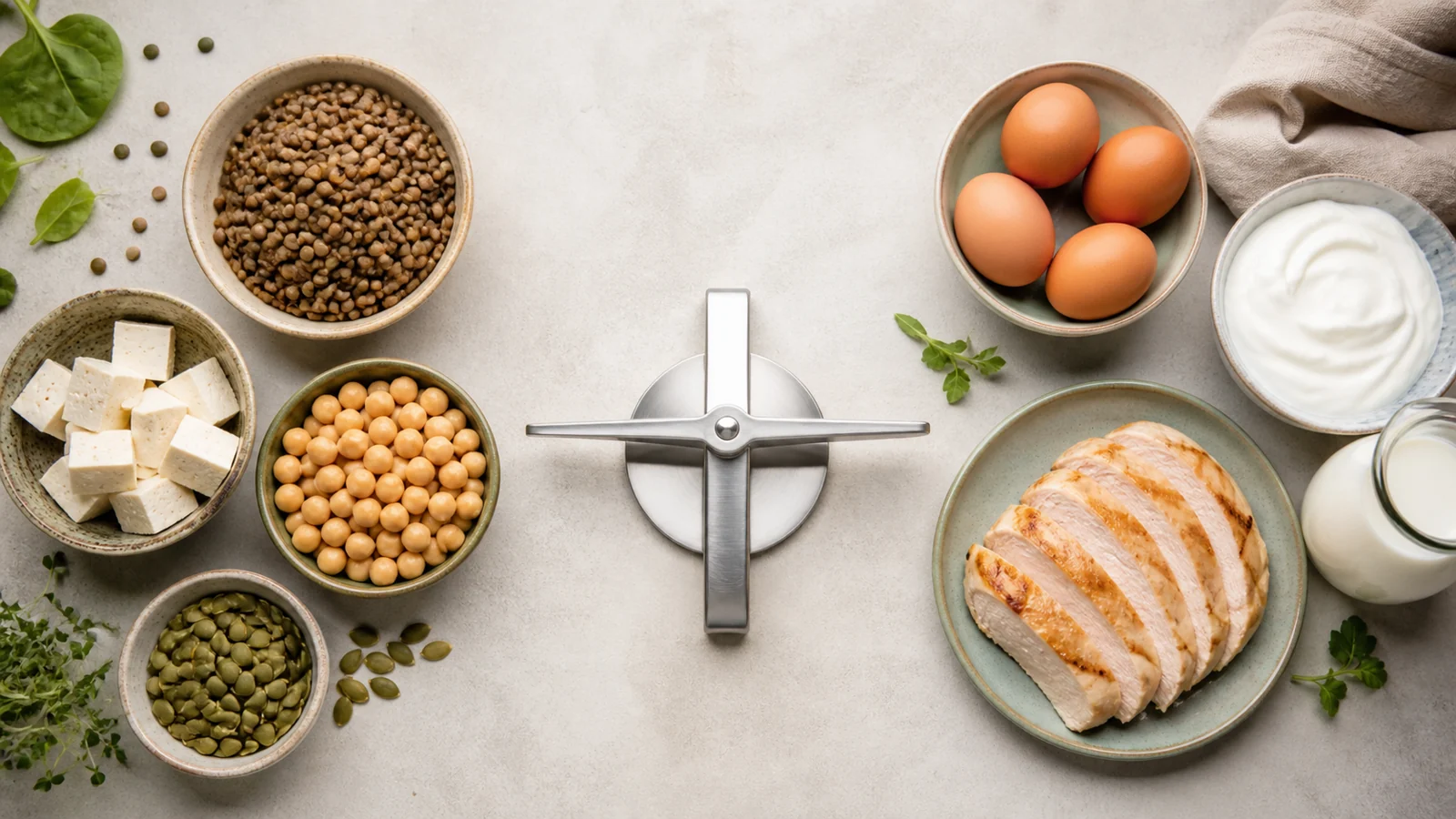
Both protein groups improved during this 12-week trial, and the researchers detected no between-group differences in the reported muscle or strength outcomes. That finding answers a specific comparison between a soy-pea supplement and whey. It does not establish that every plant protein equals every animal protein, or that two complete dietary patterns have identical effects.
The quickest way through the paper is to audit the claims people may try to attach to it.
Claim: whey produced more muscle growth
Not in the statistical comparison reported by this trial. The publication reports that 52 young untrained men were randomized, eight dropped out, and 44 completed the study and were included in the analysis. They completed supervised resistance training three times per week. Both groups improved whole-body lean mass, appendicular lean mass, leg lean mass, vastus lateralis cross-sectional area, and leg-press 1RM. No between-group difference was detected for any of those variables.
The average changes were not numerically identical. Whole-body lean mass rose 2.4 kilograms with the plant blend and 2.5 kilograms with whey. Appendicular lean mass increased by 1.2 and 1.8 kilograms; leg lean mass by 0.9 and 1.3 kilograms. Vastus lateralis cross-sectional area rose by 0.9 and 1.3 square centimeters.
Leg-press 1RM increased by 64 kilograms in the plant group and 63 kilograms in the whey group. The direct group comparison, rather than the visual size of two averages, determines whether the trial detected a difference. For every listed outcome, it did not.
This wording avoids an equivalence claim. Failure to detect a difference does not prove the two interventions have exactly the same effect under all conditions. It means the observed evidence did not separate them reliably in this sample and design.
Claim: the supplements differed only by the word “plant”
The experiment aligned the servings closely but tested two particular products. Participants consumed three 15-gram supplemental servings each day—45 grams in total—with breakfast, lunch, and dinner. One drink used a blend of soy and pea proteins; the other used whey.
The full randomized trial report describes each ready-to-drink serving as similar in energy and closely matched in protein, essential amino acids, and leucine, though not identical in every nutrient. Blending soy and pea can produce a different amino-acid profile from using one plant source alone.
The tested result therefore belongs to this soy-pea blend, this whey drink, this daily amount, and this meal distribution. Rice, wheat, pea, soy, collagen, dairy, egg, and mixed-food proteins cannot all inherit it automatically.
The 45 grams per day also sat on top of habitual food intake. Participants were recruited with reported protein consumption around the recommended dietary allowance range, and the intervention was intended to bring intake to an “optimal” range defined by the study. Three 24-hour dietary recalls were collected before the trial, then repeated at weeks 4, 8, and 12.
Claim: the study compared vegan and omnivorous diets
It did not. The participants consumed omnivorous habitual diets. Their meal patterns were not replaced by vegan or animal-based menus; they added one of two protein drinks.
That difference changes the search intent. A powder comparison can help isolate supplemental protein source. A whole-diet comparison would also need to account for total energy, fiber, micronutrients, food combinations, adherence, cooking, and substitutions. This study controlled none of those as competing dietary patterns because that was not its question.
It also says nothing about whether a vegan diet is adequate or inadequate. Readers interested in a distinct plant-based population can compare the site’s four-week creatine study in vegan athletes, where both arms followed vegan diets and the randomized variable was creatine. Neither trial is a referendum on every aspect of a diet.
Claim: the protein drinks caused all the gains
There was no unsupplemented resistance-training control. Both groups trained in a supervised, linear-periodized lower-body program three times weekly for 12 weeks. Beginners often respond quickly when they start organized resistance training.
Without a training-only or non-protein placebo group, the study cannot divide each kilogram of lean mass or each kilogram added to the leg press into a training effect and a supplement effect. It compares which protein drink accompanied the adaptations, not whether adding 45 grams of protein was necessary for them.
Measurement was broader than a scale. DXA assessed whole-body and regional lean mass, ultrasound measured vastus lateralis cross-sectional area, and leg-press 1RM assessed lower-body strength. Those methods give several views of adaptation. They still cover one thigh site, one strength exercise, and estimated lean tissue rather than every muscle and performance outcome.
The supervised program reduces uncertainty about attendance and exercise execution. It can also make the result less representative of ordinary unsupervised training. The site’s progressive-overload study review examines how training progression itself can alter hypertrophy, which is a separate lever from supplement source.
Claim: the result applies to trained lifters and everyone else
The participants were men aged 18–35 who were physically active but not resistance trained. The trial does not directly represent experienced lifters, women, older adults, adolescents, or people with clinical nutrition needs.
Twelve weeks is long enough to observe early training adaptations and short enough to leave retention and long-term progression open. An experienced athlete near a plateau may show smaller gains and could expose a difference the beginner sample did not reveal. Conversely, a larger study could tighten the estimate around little or no difference.
The registration was NCT05710614. The current ClinicalTrials.gov record reports an actual enrollment of 40. The publication reports 52 randomized and 44 completed and analysed after eight dropped out. Those totals do not align; this article reports the discrepancy without attempting to reconcile it. The journal DOI leads to the detailed methods and disclosures.
Claim: company funding either proves or erases bias
The authors reported financial support from NotCo, a plant-based food company. They stated that NotCo and its associates did not participate in study design, data collection, data analysis and interpretation, or writing the paper. Those are the roles the disclosure names; it does not say “decision to publish.”
Funding alone does not establish that the findings are wrong. It does make transparent methods, preregistration, complete reporting, and independent replication valuable. A reader can note the commercial context without inventing a role the paper does not disclose.
The trial leaves one sentence standing: with matched supplementation and supervised training, both groups improved, and no between-group differences were detected. Broader claims about dietary ideology, every protein product, or permanent equivalence require evidence this study was not built to provide.
More Diet
 Diet
DietVegan Diet, Muscle Loss, and Resistance Training in Older Adults: New Trial
In a 12-week trial, a self-selected vegan diet reduced protein intake and muscle measures in adults over 65. Resistance training mitigated, but did not erase, the losses.
 Diet
DietFood Order for Athletes: Carbs First or Vegetables and Protein First?
In 14 trained footballers, eating carbohydrate last lowered the early glucose rise but increased hunger and cravings. Later food intake did not change.
 Diet
DietCreatine With Resistance Training After 60: Strength, Muscle, and Function Evidence
A 2026 meta-analysis of 11 trials found a modest strength benefit when adults over 60 combined creatine with resistance training, while muscle and function estimates remained uncertain.