
Pre-Sleep Whey vs Casein: A Small Trial on Sleep and Recovery
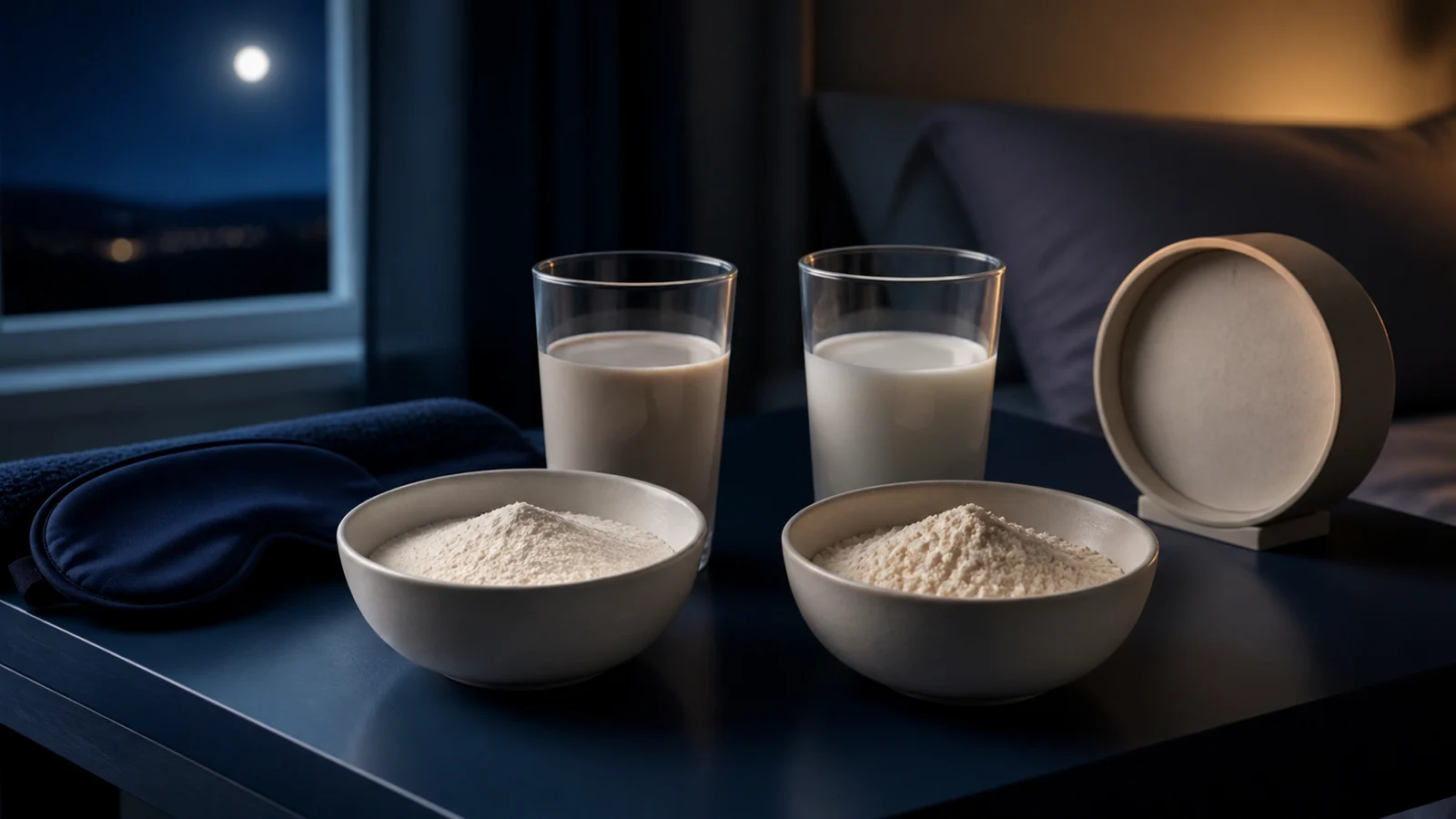
The most important comparison in this pre-sleep protein trial was whey versus carbohydrate control, not whey versus casein. Whey improved several sleep measures after resistance exercise when compared with control. The study did not detect significant whey-casein differences on those measures.
That result emerged across one night at a time. Following the sequence from the workout through the next day makes clear what the nine-person trial measured—and what it could not.
First came the resistance session
Five men and four women, all young, healthy, and resistance trained, completed three experimental occasions. Their average age was 24. After each resistance-exercise session, they received one of three drinks: 40 grams of whey, 40 grams of casein, or an isocaloric maltodextrin control. The drink was consumed 30 minutes before bed.
The randomized, double-blind crossover allowed every participant to experience every condition. This is useful for sleep research because one person’s normal sleep can differ sharply from another’s. Comparing participants with themselves removes some of that between-person variation.
Randomization reduced the chance that conditions always arrived in a favorable order, and blinding limited expectations about the drink. Those protections improve the comparison; they do not make nine people representative of all lifters or erase ordinary night-to-night variation.
The 40-gram serving and 30-minute timing are protocol details, not a bedtime prescription.
Then the clock measured sleep onset
Median sleep-onset latency was 9 minutes after whey, 16 after casein, and 19 after control. Whey differed significantly from control. Whey did not differ significantly from casein.
That last sentence prevents the wrong headline. Descriptively, casein sat between whey and control. Statistically, this small trial did not establish that whey put participants to sleep faster than casein. Nor does a single post-exercise occasion show that whey treats difficulty falling asleep in everyday life.
The medians also need their ranges and paired data for full interpretation. A group median can shift even when individual responses vary in direction. The primary paper, rather than a difference between two headline numbers, is where the repeated-measures analysis determines which contrasts met the statistical threshold.
Sleep was estimated with actigraphy, which infers sleep and wake from movement. Actigraphy can capture a night outside a full sleep laboratory, but it is not polysomnography. It does not collect the same brain, eye, muscle, respiratory, and cardiac channels used to characterize sleep stages and clinical sleep disorders.
Across the night, three measures favored whey over control
Sleep efficiency was 96% after whey, 96% after casein, and 93% after control. Total sleep time was 400, 390, and 363 minutes, respectively. Participants gave median subjective sleep ratings of 8 after whey, 7 after casein, and 6 after control.
Whey was significantly better than control on sleep efficiency, total sleep time, and subjective sleep rating. Again, none of those whey-casein comparisons was significant.
The combination of actigraphy and a subjective questionnaire is useful because it shows both estimated sleep behavior and how the night felt. It remains a small set of acute observations. An extra 37 minutes in the median whey-control comparison is not a guaranteed personal result, and it should not be projected across months.
The paper appeared online July 7, 2026. PubMed lists September 1, 2026, for volume 36, issue 5; that later date was the forthcoming issue assignment when the source registry was checked. The journal record identifies the same primary report.
Morning brought a split recovery picture
Soreness was lower 12 and 24 hours after whey than after control. That gives the experiment a second positive whey-control finding outside the sleep measurements.
Next-day exercise performance did not differ among treatments. Feeling less sore did not translate into a detected performance advantage on the tests used. The paper also found no treatment differences in heart-rate-variability variables.
These null results keep “recovery” from becoming a vague umbrella. Soreness changed in one comparison; autonomic measures and exercise performance did not. A person can report less discomfort without producing more force or work the next day.
Gastrointestinal symptoms did not differ among treatments either. Within these nine healthy adults and these single servings, the researchers detected no condition effect on the monitored symptoms. The result says little about milk allergy, lactose intolerance, gastrointestinal disease, different formulations, or repeated daily use.
Casein was neither the winner nor the loser
The study title emphasizes that whey, but not casein, improved sleep quality compared with control. Statistical significance does not let us infer a significant difference between two active conditions merely because one reached a threshold against control and the other did not. The direct whey-casein tests were nonsignificant.
That does not prove exact equivalence. With nine participants, the experiment may have been unable to detect a modest difference. The accurate statement is that it found no significant whey-casein difference, not that the proteins are identical or interchangeable in every setting.
The trial also did not measure overnight muscle protein synthesis, muscle growth, or strength development over a training block. Pre-sleep protein may help someone distribute daily protein, but this paper cannot answer whether either product adds hypertrophy. The site’s bodybuilding foods guide places protein sources inside a broader diet rather than one controlled night.
By the second day, the experiment was already at its limit
Acute crossover studies are good at asking whether conditions differ under a tightly repeated sequence. They are poor substitutes for long-term feeding trials. This one included healthy trained adults after resistance exercise, not people with diagnosed insomnia or clinical recovery problems.
Whey’s advantage over carbohydrate control covered sleep onset, efficiency, duration, subjective rating, and soreness. It stopped short of casein superiority, improved next-day performance, or a uniform physiological recovery signal. Any claim about long-term sleep treatment or muscle gain starts after the trial’s evidence ends.
More Diet
 Diet
DietVegan Diet, Muscle Loss, and Resistance Training in Older Adults: New Trial
In a 12-week trial, a self-selected vegan diet reduced protein intake and muscle measures in adults over 65. Resistance training mitigated, but did not erase, the losses.
 Diet
DietFood Order for Athletes: Carbs First or Vegetables and Protein First?
In 14 trained footballers, eating carbohydrate last lowered the early glucose rise but increased hunger and cravings. Later food intake did not change.
 Diet
DietCreatine With Resistance Training After 60: Strength, Muscle, and Function Evidence
A 2026 meta-analysis of 11 trials found a modest strength benefit when adults over 60 combined creatine with resistance training, while muscle and function estimates remained uncertain.